Chuyển đến nội dung chính

San Francisco Launches Safety - It’s Your Turn Campaign

San Francisco Launches Safety - It’s Your Turn Campaign
By Christine Osorio

In San Francisco, left turns are one of the top three crash factors in severe injuries and fatal collisions for people walking and biking. SFMTA is kicking off the new year with a city-wide education campaign designed to encourage safer driving behavior around left turns. The Safety - It’s Your Turn campaign will use multiple strategies, including grants to community organizations, to engage the public at different times and raise awareness about unsafe left turns.

Drivers especially will see the Safety - It’s Your Turn messaging on billboards and buses, hear about it on the radio, and read about it on social media and in newspapers. This community education program also accompanies the SFMTA’s Left-Turn Traffic Calming Project.  Under that project, launched in October 2020, the SFMTA installed safety infrastructure at 7 intersections on the High Injury Network.
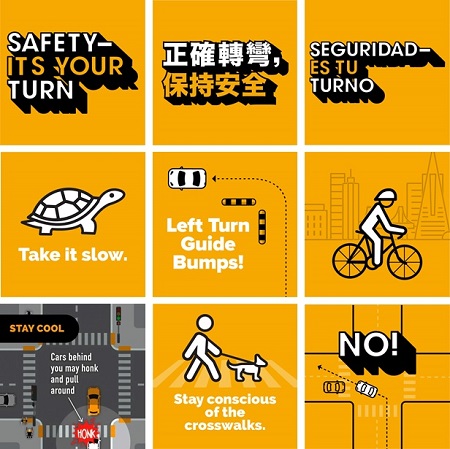
nine posters with these messages: "safety it's your turn" in english, chinese and spanish, "take it slow" with an image of a turtle, "left turn guide bumps" with an image of a car turning left by guide bumps, an image of a cyclist wearing a helmet, "stay cool" because "cars behind you may honk and pull around", an image of a human walking a dog with the message "stay conscious of the sidewalks", and an image of a car turning left encroaching the wrong lane with the message "no"

Community Grant Awardees

After a competitive application process, the SFMTA has awarded six grants to community organizations around the city to amplify the Safety It’s Your Turn campaign.  Community organizations are closer to the communities they serve and are better positioned to develop culturally-responsive outreach programs and materials. In addition to sharing safe left-turn messaging, another objective of the grant is to reach communities historically underserved by transportation projects. For many of the organizations, this is their first-time developing Vision Zero messaging, and the SFMTA is pleased to be expanding its engagement with community stakeholders and leaders. The selected grantees include:

These community groups plan to share safe left-turn messaging directly to food-delivery drivers, hard-to-reach communities along the High Injury Network, teen drivers, and vulnerable road-users. Examples of the deliverables include map booklets for the visually impaired, teen driver safety kits, and art-inspired public service announcements.

Remember that 40% of traffic fatalities in San Francisco involve drivers making left turns. Drivers can make a safe left turn by yielding to pedestrians and bicyclists, taking it slow at less than 5 mph, and making their turn nice and wide.
Image with the caption "anatomy of a left turn" with a link to video

Watch: Anatomy of a Left Turn

Vision Zero

San Francisco adopted Vision Zero (www.visionzerosf.org)as a policy in 2014, committing to build better and safer streets, educate the public on traffic safety, enforce traffic laws, and adopt policy changes that save lives. The result of this collaborative, citywide effort is safer, more livable streets as San Francisco works towards the Vision Zero goal of zero traffic fatalities. San Francisco is engineering inherently safer streets, enforcing traffic laws more effectively, and targeting traffic-safety education to reach its Vision Zero goals.


Published January 21, 2021 at 11:30PM
https://ift.tt/3c1gvbY

Nhận xét

Bài đăng phổ biến từ blog này

Đảm bảo tiêu chí Coherence và Cohesion trong IELTS Writing

Coherence & Cohesion là một trong bốn tiêu chí chủ chốt để đánh giá bài IELTS Speaking và Writing . Trong bài viết dưới đây, mời các bạn cùng IELTS Vietop tham khảo lại định nghĩa và những cách để đảm bảo tiêu chí Coherence và Cohesion trong IELTS Writing nhé! Tiêu chí Coherence và Cohesion trong IELTS Writing là gì? Tiêu chí Coherence & Cohesion là hai khía cạnh quan trọng trong việc đánh giá và phân tích một bài IELTS Writing. Trong đó: Tiêu chí Coherence và Cohesion trong IELTS Writing là gì Coherence (tính liên kết): Mức độ mà các ý tưởng trong văn bản liên kết với nhau một cách hợp lý và có tổ chức. Nó đảm bảo rằng các ý tưởng trong văn bản được trình bày theo một cách mạch lạc và dễ hiểu. Người viết cần sử dụng các từ nối, cụm từ, và cấu trúc câu hợp lý để giúp cho các ý tưởng trong văn bản được trình bày một cách logic và mạch lạc. Cohesion (tính gắn kết): Mức độ mà các câu trong văn bản gắn kết với nhau một cách hợp lý và tự nhiên. Nó đảm bảo rằng các câu t...

IELTS Reading – Cách xử lý dạng câu hỏi True False Not given

Đối với các bạn đang luyện tập và chuẩn bị cho kỳ thi IELTS sắp tới, một trong những dạng bài quen thuộc nhưng khá khó đối phó chính là dạng bài True False Not Given . Dạng bài này thường bị nhầm lẫn với dạng bài Yes/ No/ Not Given và hay bị nhầm lẫn trong kết quả. Hãy cùng IELTS Vietop chinh phục dạng bài này trong bài viết dưới đây nhé! Tổng quan về dạng bài True False Not Given trong IELTS True False Not Given là một trong những dạng bài xuất hiện trong phần bài đọc của bài thi IELTS. Thường trong mỗi bài đọc sẽ xuất hiện một bài tập dạng True/False/Not Given với độ dài khoảng 5 – 7 câu. Dạng bài này đánh giá khả năng đọc hiểu của thí sinh.  Đề bài sẽ đưa ra các mệnh đề chứa nội dung liên quan đến bài đọc. Thí sinh sẽ phải đọc thông tin trong bài và đưa ra đáp án rằng mệnh đề đó đúng, sai hay không có thông tin.  Phân biệt hai dạng bài True/False/Not Given và Yes/ No/ Not Given Dạng bài True False Not Given thường hay bị nhầm với dạng bài Yes No Not Given. Hai dạng bà...

Writing samples: Physical activities

Luyện thi IELTS Vietop  gửi bạn bài Writing samples: Physical activities   bên dưới nhé! Các bạn theo dõi và ôn luyện  IELTS Writing  thật tốt nhé! Task 1: The bar chart below shows the percentage of Australian men and women in different age groups who did regular physical activity in 2010. The bar chart depicts the percentages of Australian males and females in various age groups who exercised regularly in 2010. Overall, men’s engagement peaked between the ages of 15 and 24, while women’s participation peaked in the 45 to 54 age group. Besides, in every age group save the youngest, more women than men participated in regular exercise. Women in the youngest age group who regularly exercised were 47.7%. After then, their participation increased significantly with age, peaking at 3% over a half in the 45-54 age group. Above that, it began to deteriorate, with only 47.1% of people in the most senior age group engaging in regular workout. The lowest age ...