By Julie Kirschbaum
Much of Muni service has already been restored since the pandemic-related service reductions at the beginning of the crisis, thanks to the dedication of SFMTA staff. As San Francisco emerges from the pandemic, we continue to increase service by focusing on maximizing citywide Muni access while providing high frequency on the city’s busiest routes.
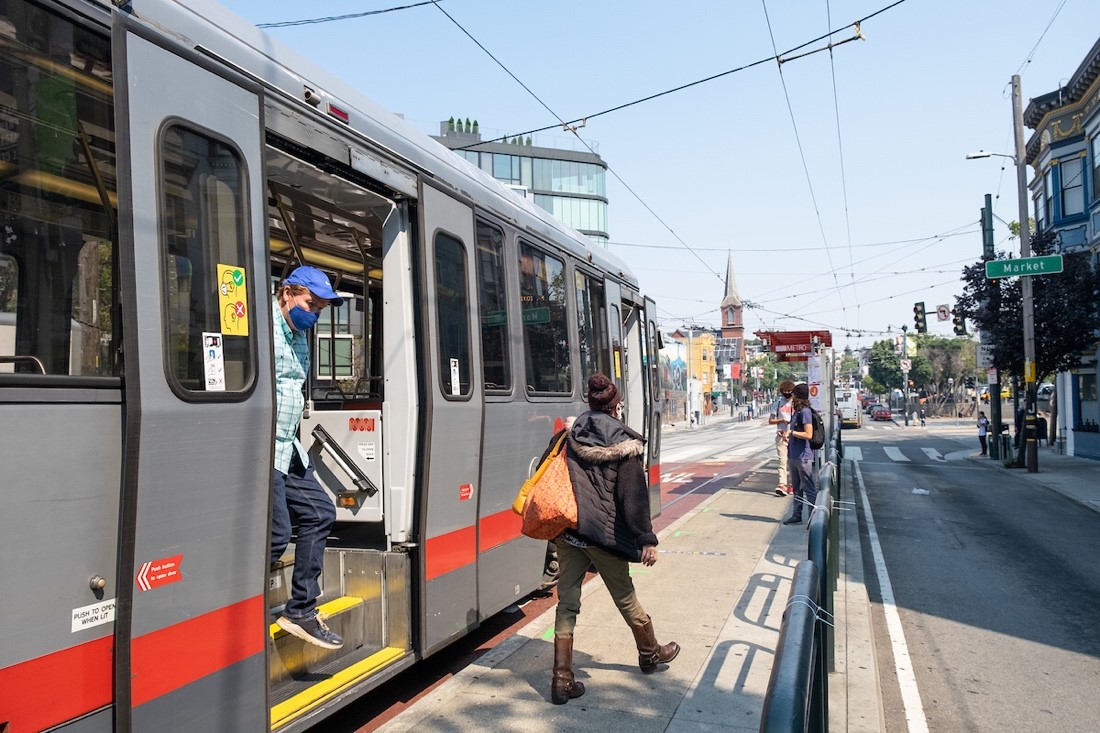
The J Church returned as a surface route from Balboa Park to Duboce Avenue in December 2020
Since January 23, 91% of San Franciscans are within 2-3 blocks of a Muni stop. And this includes 100% of residents in San Francisco’s neighborhoods identified in the Muni Service Equity Strategy.
On May 15, Muni Metro service will be restored in the subway, providing subway service at all stations from Embarcadero to West Portal. The K Ingleside and the T Third will once again be “interlined,” operating as one route from Balboa Park to Sunnydale. The N Judah is also returning to rail service, giving customers more room and fewer pass ups, as the two-car train increases the N Judah’s capacity. F Market & Wharves service will return 7 days a week, 11 a.m. to 7 p.m. And, a hilltop gap will be closed between Forest Hill and Glen Park with the temporary 36-52 Special Shuttle bus.
SFMTA staff are working hard and fast to overcome constraints to restoring service, and we expect to be able to expand service so that 98% of San Franciscans will be within 2-3 block of a Muni stop by the end of the summer. Here’s how.
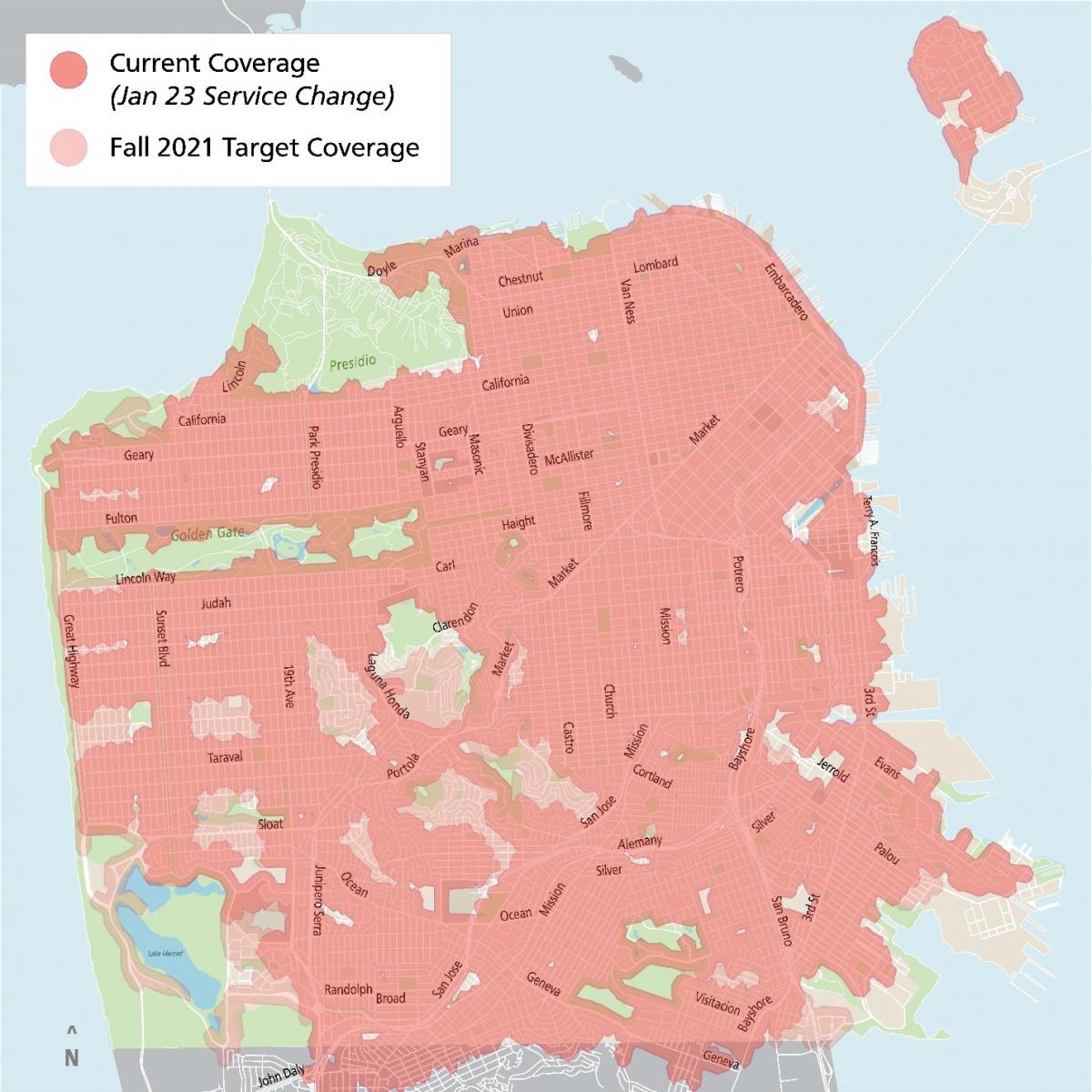
As of January 23, 2021, 91% of San Franciscans are within 2-3 blocks of a Muni stop. We expect 98% of San Franciscans to have this access by the end of summer.
Vehicle Capacity and Availability Limits
As public health officials monitor San Francisco’s decreasing COVID-19 case numbers and increasing COVID-19 vaccination rates, we are working closely with the Department of Public Health to determine when distancing restrictions should be lessened, allowing more customers on each bus and train.
When distancing requirements are no longer needed, each Muni bus and train will be able to carry up to three times more customers comfortably. We will also return to industry standards of cleaning vehicles at the end of the day and stop our pandemic practice of returning a vehicle at the end of each operator’s shift for sanitization that currently limits vehicle availability.
Additionally, buses are currently substituting for Muni Metro lines while work on the first part of the Subway Renewal Program is completed, that is further reducing vehicle availability. The SFMTA maintenance, engineering and technology teams have worked hard over the last 10 months to ensure that the subway will open up with better reliability, as well as important customer facing amenities such as Wi-Fi and new station signage at Church and Castro. In May, the bus substitution will not be needed on the N Judah and K Ingleside lines and can then be used on other routes.
Muni Staffing and Funding
Also, essential to providing great Muni service is retaining staff talent. Due to a 15% vacancy rate pre-pandemic across the agency and very limited hiring over the past year, we have vacancies in many service critical positions from mechanics to supervisors. Before we can restore more service, we need to conduct exams, hire and train. Additionally, a high wave of June retirements is expected due to a reduced number of retirements during the pandemic. Since we are expecting a challenging summer due to high promotions and attrition, we are restoring Muni service with a schedule that can be filled 100% with available operators without gaps going forward. We want to make sure that as we start up service, we can sustain it long term.
In the short term, with ridership expected to take several years to reach pre-pandemic levels, we will be able to meet the city’s transit needs without over-extending our resources. However, I am confident that if we bring back Muni service that is reliable and convenient, demand will return stronger than ever.
Thanks to our diligent teams, we are making cost efficient improvements to Muni service. SFMTA staff looked closely where we had vulnerabilities and talked openly about how to learn from past mistakes. Union leadership has fought tirelessly for the needs of their team members and show up every day to solve tough problems. From headway management to installing temporary emergency transit lanes, we are creating an enhanced customer experience that will foster financial sustainability for the long term.
While we are on our way to increasing service, getting Muni back to 100% of pre-pandemic service — not to mention any increases—requires more sustained funding. Even before the pandemic, the agency had seen declining revenues from parking fees and transit fares. Now, with ridership slow to return to past levels and tax revenues down, our future is even less clear. One-time federal funding has saved the SFMTA from devastating cuts and layoffs, but this one-time funding runs out in 2023 and doesn’t solve the long-term funding challenge.
The SFMTA is exploring several options including revenue measures to secure our future. And while we plan to passionately pursue expanded funding, we will not expand service beyond what we can sustain with ongoing revenue to protect jobs and prevent future layoffs.
Muni is more than a transit system—it's a core part of our community and fabric of our city. Our staff is committed to keeping San Francisco moving and is working hard to bring Muni service back better than ever.
Published April 21, 2021 at 12:34AM
https://ift.tt/3v3KLJk
Nhận xét
Đăng nhận xét