Chuyển đến nội dung chính

Street Transformations to Address COVID-19 Keep San Francisco Moving

Street Transformations to Address COVID-19 Keep San Francisco Moving
By Eillie Anzilotti

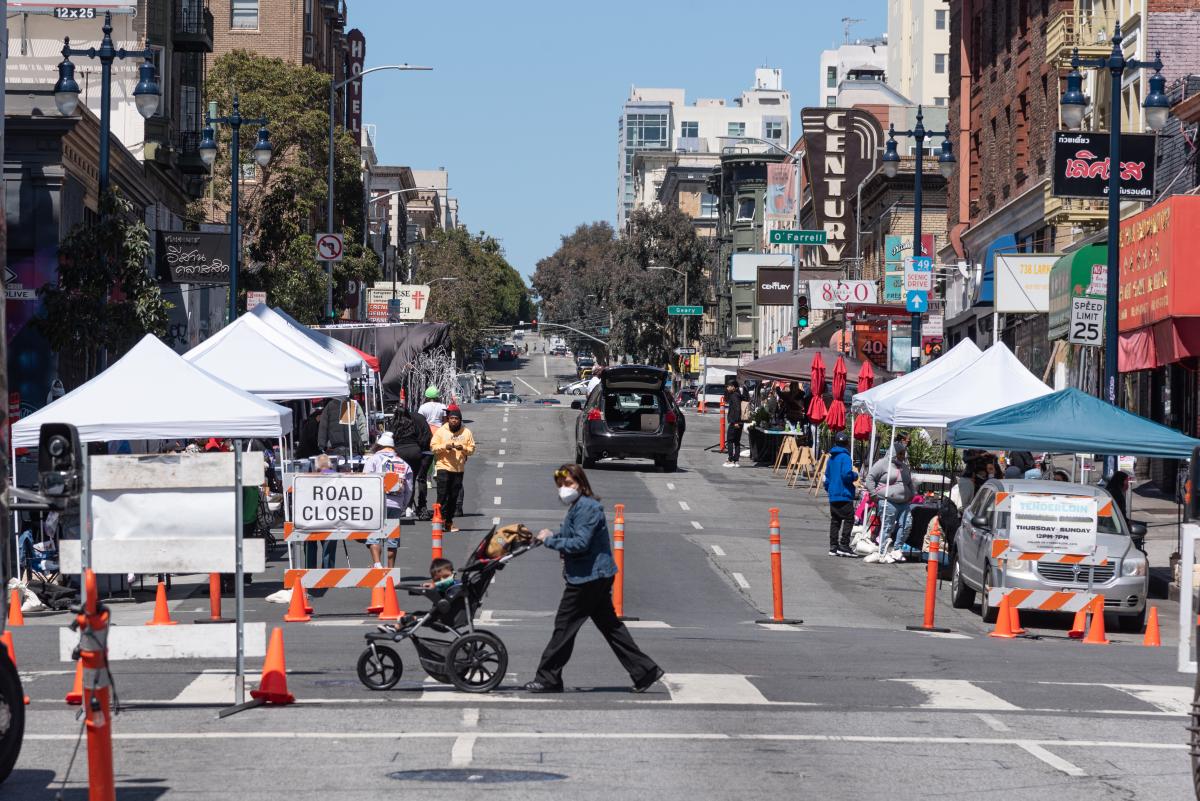
Photo of a slow street in the Tenderloin neighborhood

A street closure in the Tenderloin as part of the COVID-19 response efforts.

Since the start of the COVID-19 pandemic in March 2020, many aspects of people’s lives have changed – including how we get around town. To reflect this new reality, the SFMTA pivoted in the way we design and operate our streets. From streets that prioritized people walking and bicycling in some of San Francisco’s major parks to Temporary Transit Lanes (TETLs) that protected Muni lines from the return of traffic congestion, San Francisco reimagined how streets could be used for people.

We have documented some of these transformations in a new report that highlights emergency street operations, Temporary Emergency Transit Lanes, the Slow Streets Program, Tenderloin street closures and reusing streets within or close to parks for recreational purposes. Within each effort, the report touches on the ways in which city programs have been responsive, equitable and people-centered.

Some highlights of our COVID-19 response work over the last year include:

  • The SFMTA implemented over 700 street changes to remove parking and close streets based on the request of essential service providers, including medical care, food banks, testing sites and more. The majority of these requests were filled in less than three days.
  • 12.5 miles of Temporary Emergency Transit Lanes (TETLs) were installed, significantly reducing travel times for tens of thousands of riders. For instance, after transit lanes were installed, transit travel times on Mission Street in the South of Market neighborhood stayed constant, even as traffic volumes increased by 20%. Travel times on the 14 Mission and 14R Mission Rapid are now 20% faster than pre-pandemic.
  • The SFMTA installed 45 lane miles of Slow Streets during the pandemic. On average, traffic volumes decreased by over 50% after Slow Streets treatments were installed, while bicycle ridership increased by over 70%.
  • Two miles of safer and calmer street treatments were implemented in the Tenderloin, including block closures for essential services, physical distancing lanes for increased walking space, shared spaces and play streets.

In response to unprecedented circumstances, the SFMTA has delivered a suite of responsive, innovative programs and projects within short timelines. Some aspects of these new programs and projects, such as Slow Street corridors, have demonstrated benefits beyond emergency response and are now moving towards a permanent, post-pandemic future.

Additional programs will continue to be monitored for their value and effectiveness within a rapidly evolving environment. As the pandemic continues and the needs of our streets and residents continue to shift, the SFMTA is committed to keeping San Francisco moving.


Published October 20, 2021 at 04:38AM
https://ift.tt/3n8e5Mo

Nhận xét

Bài đăng phổ biến từ blog này

Writing samples: Physical activities

Luyện thi IELTS Vietop  gửi bạn bài Writing samples: Physical activities   bên dưới nhé! Các bạn theo dõi và ôn luyện  IELTS Writing  thật tốt nhé! Task 1: The bar chart below shows the percentage of Australian men and women in different age groups who did regular physical activity in 2010. The bar chart depicts the percentages of Australian males and females in various age groups who exercised regularly in 2010. Overall, men’s engagement peaked between the ages of 15 and 24, while women’s participation peaked in the 45 to 54 age group. Besides, in every age group save the youngest, more women than men participated in regular exercise. Women in the youngest age group who regularly exercised were 47.7%. After then, their participation increased significantly with age, peaking at 3% over a half in the 45-54 age group. Above that, it began to deteriorate, with only 47.1% of people in the most senior age group engaging in regular workout. The lowest age ...

Cùng chia sẻ bí quyết đạt 990 điểm Toeic

Đọc sách, tham quan phim, nhớ về điều mình thích... chính là bí kíp đạt 990/990 điểm TOEIC ngay dưới lần thi trước tiên của Nguyễn Sơn Nam (ĐH Kinh Tế).Nào chúng ta cùng tham quan cậu Sinh Viên này ôn luyện như thế nào để đạt được điểm số đắt như vậy nhé. Trong buổi hội thảo TOEIC dưới tầm tay diễn ra vào cuối tuần qua ở ĐH Kinh Tế TP.HCM, Sơn Nam đã mách nhỏ một số kinh nghiệm của mình. Bí kíp lớn nhất mà Sơn Nam share chính là học tiếng Anh một cách nhẹ nhàng. Học bằng cách tham quan phim và đọc thật nhiều. Nguyễn Sơn Nam- 990/990 TOEIC (Trung tâm IIG TP Hồ Chí Minh) Theo Nam, ban đầu những bạn hãy tham quan một số bộ phim đơn giản nhưng đầy giải trí của Disney. Sau đó là những kênh khoa học Discovery, National Geographic. Nam cũng chia sẻ bí quyết rằng, sách tiếng Anh rất nhiều và rất dễ dàng dưới việc học tập. Nam...

Reading Practice: Australian parrots and their adaptation to habitat change

A Parrots are found across the tropic and in all southern hemisphere continents except Antarctica, but nowhere do the display such a richness of diversity and form as in Australia. One- sixth of the world’s 345 parrot species are found there, and Australia has long been renowned for the number and variety of its parrots. B In the 16th century, the German cartographer Mercator made a world map that included a place, somewhere near present-day Australia, that he named Terra Psittacorum – the Land of Parrots – and the first European settlers in Australia often referred to the country as Parrot Land. In 1865, the celebrated British naturalist and wildlife artist John Gould said: “No group of birds gives Australia so tropical and benign an air as the numerous species of this great family by which it is tenanted. C Parrots are descendants of an ancient line. Due to their great diversity, and since most species inhabit Africa, Australia and South America, it seems almost certain that pa...