Chuyển đến nội dung chính

Track Work Through the Years

Track Work Through the Years
By Jeremy Menzies

San Francisco’s unique rail system brings together 150-year-old cable cars, historic electric streetcars of all shapes and sizes and modern light rail vehicles.  

Many trades across the SFMTA play a critical role in keeping the system moving. This month we look back in time at the work of one such group, the Track Department. While the lines and technologies of SF’s street railway have changed over the years, some of the base-level work, tools and skills needed to maintain our tracks are the same today as they were over 100 years ago. 

A decade before Muni was founded, the United Railroads Company (URR) dominated San Francisco’s transit system. URR owned and operated nearly 400 miles of street and cable car track all over the city. To keep this network in service, their track department was fully equipped to handle any possible construction or repair job. 
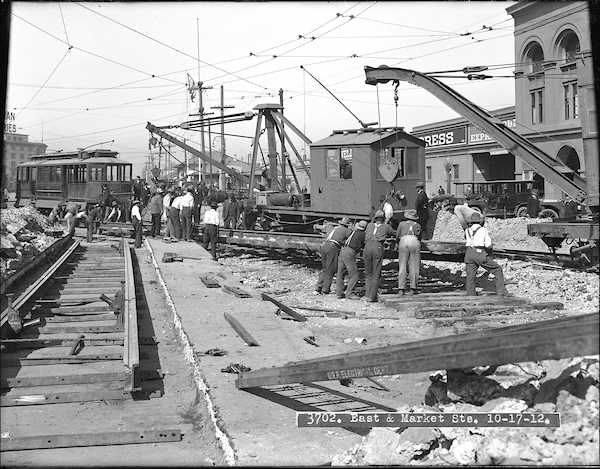
Black and white photo of group of people moving section of tracks with cranes

All hands were on deck for this job outside the Ferry Building in 1912. Here, two special work streetcars equipped with cranes lift an entire section of track in one piece. 

The Municipal Railway was built in 1912 and expanded over the next 16 years to include multiple lines and two dedicated tunnels. The city relied on its own team to maintain this system on a daily basis.  

Following World War II, many streetcar lines were converted to bus routes, but Muni retained the J, K, L, M, and N streetcar lines. With those core lines still in service, the work of the Track Dept. continued. 
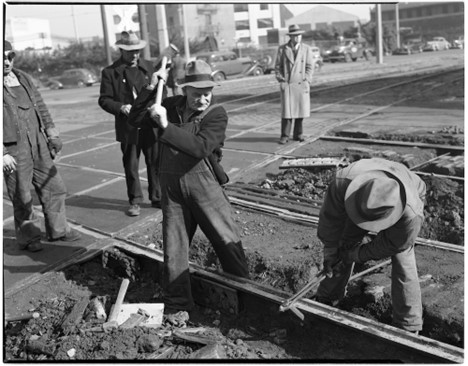
Black and white photo of two people working on tracks. One holds a rail spike while the other strikes it with a large hammer

Taken on January 31, 1947, this photo shows Muni track workers Pat Kellerher and Con Maloney at Division and Bryant Streets.

In the 1970s, construction of the Market Street Subway transformed the city’s streetcar lines into the Muni Metro system. Miles of tracks were rebuilt to handle light rail vehicle (LRV) traffic, and an automatic train control system was introduced for subway operations.
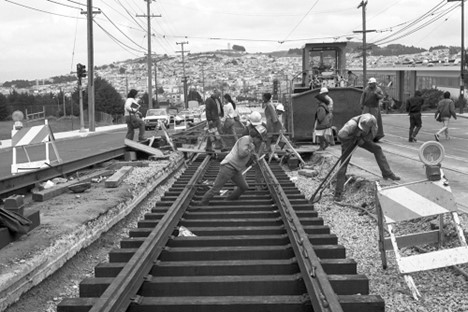
Group of people working on tracks, one pushes a rail while the other lifts a tie into place

In this 1977 shot, a crew replaces K Line tracks on Ocean Avenue just outside Lick-Wilmerding High School.

Today the SFMTA Track Department is primarily responsible for maintaining and repairing our rail infrastructure. Outside of this, they take on other jobs moving cable cars to and from the cable car carpentry shop, hauling heavy equipment in the subway, and supporting the work of the teams that maintain and repair our stations. With the skilled labor, know-how, and equipment to do a variety of heavy jobs, the department plays a critical role in keeping Muni moving.
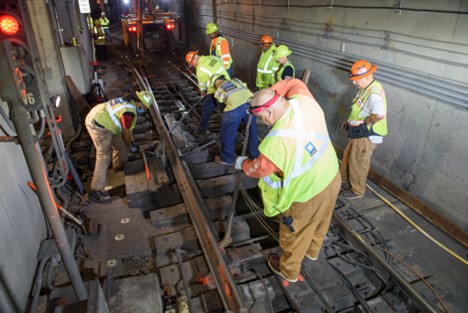
Photo of group of people lifting rail with a jack and pry bars

Whether it’s 1903 or 2023, track work is a team effort. This photo was taken during the March 2023 Fix-It Week when the Track team replaced sections of rail in the Van Ness Crossover.


Published April 27, 2023 at 05:23AM
https://ift.tt/0EWfQxa

Nhận xét

Bài đăng phổ biến từ blog này

Đảm bảo tiêu chí Coherence và Cohesion trong IELTS Writing

Coherence & Cohesion là một trong bốn tiêu chí chủ chốt để đánh giá bài IELTS Speaking và Writing . Trong bài viết dưới đây, mời các bạn cùng IELTS Vietop tham khảo lại định nghĩa và những cách để đảm bảo tiêu chí Coherence và Cohesion trong IELTS Writing nhé! Tiêu chí Coherence và Cohesion trong IELTS Writing là gì? Tiêu chí Coherence & Cohesion là hai khía cạnh quan trọng trong việc đánh giá và phân tích một bài IELTS Writing. Trong đó: Tiêu chí Coherence và Cohesion trong IELTS Writing là gì Coherence (tính liên kết): Mức độ mà các ý tưởng trong văn bản liên kết với nhau một cách hợp lý và có tổ chức. Nó đảm bảo rằng các ý tưởng trong văn bản được trình bày theo một cách mạch lạc và dễ hiểu. Người viết cần sử dụng các từ nối, cụm từ, và cấu trúc câu hợp lý để giúp cho các ý tưởng trong văn bản được trình bày một cách logic và mạch lạc. Cohesion (tính gắn kết): Mức độ mà các câu trong văn bản gắn kết với nhau một cách hợp lý và tự nhiên. Nó đảm bảo rằng các câu t...

Writing samples: Physical activities

Luyện thi IELTS Vietop  gửi bạn bài Writing samples: Physical activities   bên dưới nhé! Các bạn theo dõi và ôn luyện  IELTS Writing  thật tốt nhé! Task 1: The bar chart below shows the percentage of Australian men and women in different age groups who did regular physical activity in 2010. The bar chart depicts the percentages of Australian males and females in various age groups who exercised regularly in 2010. Overall, men’s engagement peaked between the ages of 15 and 24, while women’s participation peaked in the 45 to 54 age group. Besides, in every age group save the youngest, more women than men participated in regular exercise. Women in the youngest age group who regularly exercised were 47.7%. After then, their participation increased significantly with age, peaking at 3% over a half in the 45-54 age group. Above that, it began to deteriorate, with only 47.1% of people in the most senior age group engaging in regular workout. The lowest age ...

IELTS Reading – Cách xử lý dạng câu hỏi True False Not given

Đối với các bạn đang luyện tập và chuẩn bị cho kỳ thi IELTS sắp tới, một trong những dạng bài quen thuộc nhưng khá khó đối phó chính là dạng bài True False Not Given . Dạng bài này thường bị nhầm lẫn với dạng bài Yes/ No/ Not Given và hay bị nhầm lẫn trong kết quả. Hãy cùng IELTS Vietop chinh phục dạng bài này trong bài viết dưới đây nhé! Tổng quan về dạng bài True False Not Given trong IELTS True False Not Given là một trong những dạng bài xuất hiện trong phần bài đọc của bài thi IELTS. Thường trong mỗi bài đọc sẽ xuất hiện một bài tập dạng True/False/Not Given với độ dài khoảng 5 – 7 câu. Dạng bài này đánh giá khả năng đọc hiểu của thí sinh.  Đề bài sẽ đưa ra các mệnh đề chứa nội dung liên quan đến bài đọc. Thí sinh sẽ phải đọc thông tin trong bài và đưa ra đáp án rằng mệnh đề đó đúng, sai hay không có thông tin.  Phân biệt hai dạng bài True/False/Not Given và Yes/ No/ Not Given Dạng bài True False Not Given thường hay bị nhầm với dạng bài Yes No Not Given. Hai dạng bà...