By Stephen Chun
Delivering on Your Service Priorities
The Fiscal Year (FY) 2023 & 2024 SFMTA Budget was passed by the SFMTA Board of Directors last week. It will be submitted to the Mayor’s Office by May 1, and the mayor will then send the budget to the Board of Supervisors on June 1.
This budget cycle, we approached outreach as a city-wide listening session. Rather than presenting a pre-set budget to our stakeholders, customers and the wider community for feedback, we focused on soliciting feedback and then crafted our budget to address the top community priorities.
Community Survey Highlights
- Surveys were offered in English, Chinese, Spanish and Filipino both online and in print. They included an open-ended question to ensure San Franciscans had a real opportunity to provide specific feedback about service priorities.
- 1,295 responses from online and paper surveys in four languages
- 917 additional comments from listening sessions, phone calls, and emails
- Feedback from the SFMTA Board of Directors and Citizens Advisory Council
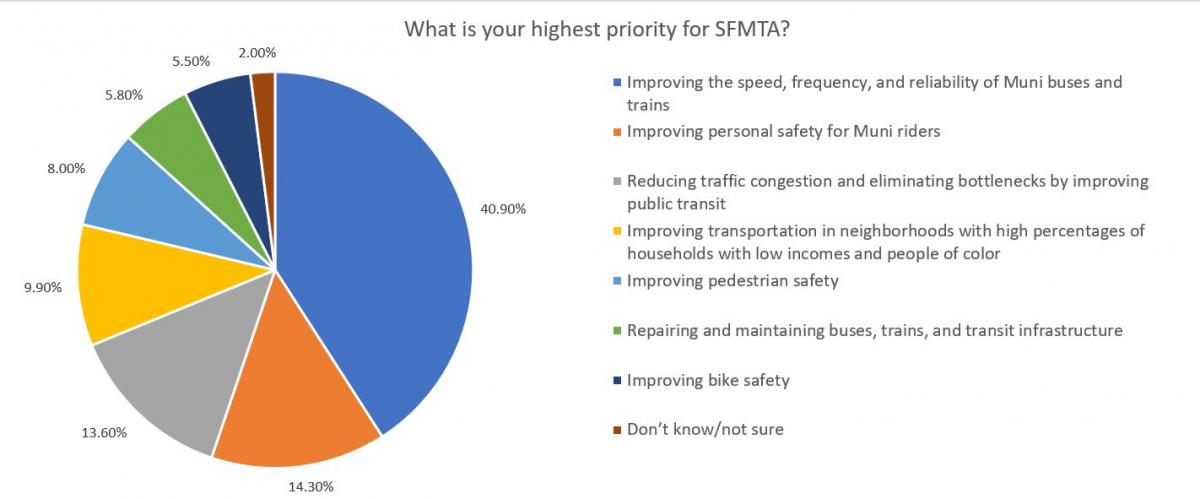
Budget Highlights: Equity, Reliability and Safety
As a direct result of your feedback, the SFMTA FY 2023 & 2024 budget has doubled down on our long-standing commitment to ensuring equity in San Francisco’s public transportation network. To improve reliability, we’ve made the largest investment in decades for State of Good Repair, which refers to the condition in which the SFMTA’s capital assets can operate at a full level of performance. To ensure that all our riders feel safe, we’ve increased investments in Muni safety, including funding a new Safety Equity Initiative designed to reduce gender-based harassment and violence on Muni.
EQUITY
For San Francisco to be an equitable community, we must fully invest in a robust transportation system that ensures that everyone--especially people who have the fewest transportation options and rely most on Muni--can access jobs and services throughout San Francisco. This means that we made the following investments to ensure Muni remains safe and affordable for all who rely on it, including:
- No fare increases for the two-year budget period (pause fare indexing)
- Free Muni for All Youth continues
- Pilots of new fare programs , such as a 10-Trip Pass
- More Muni service, especially for neighborhoods identified by the Muni Service Equity Strategy
RELIABILITY
To make Muni faster and more reliable, we’ll be investing an unprecedented amount in State of Good Repair because a broken bus or train reduces reliability and impacts all our riders. Based on what we have heard and the feedback we have received, the updated 5-Year Capital Improvement Program (CIP) will fund critical investments in transit speed and reliability projects, through significant investments in State of Good Repair:
- Continue replacement of the Breda Light Rail Vehicles
- Replacement of the subway’s Muni Metro Train Control System
- Muni Bus Fleet Mid-Life Overhauls
- Upgraded Facilities for improved maintenance
The FY 2023 & 2024 budget also invests in street improvements that have proven to increase Muni reliability, such as transit lanes, bus bulbs and smart traffic signals. Similar improvements on the 9R San Bruno, 5R Fulton and 14 Mission have improved the rider experience and increased both reliability and ridership.
To further increase reliability, we must invest in larger infrastructure projects, like upgrading our 100-year-old bus yards so we’re able to repair modern buses more quickly. We are aggressively pursuing state and federal grants to support San Francisco’s transportation infrastructure needs and fill holes on the capital funding side of the budget. We will know how much funding is needed after voters decide on the Muni Reliability and Street Safety Bond measure that’s on the ballot in June 2022.
SAFETY
The FY 2023 & 2024 Budget includes 53% more funding than the previous two-year budget for Quick Build projects that slow down vehicle speeds and increase pedestrian visibility and safety, which will help us achieve our Vision Zero goal to eliminate traffic-related fatalities and serious injuries.
We also know that for the SFMTA to increase ridership and reduce car use – one of the most important changes in our fight against climate change – riders need to feel safe. Consequently, the FY 2023 & 2024 Budget:
- Increases the number of staff in our Security Intelligence Center. These staff will analyze data, gather intelligence and review security video footage to identify patterns and direct security response 24 hours a day.
- Funds a new Safety Equity Initiative designed to reduce gender-based harassment and violence on Muni.
- Fully funds the security budget and staffing from our last two-year budget cycle that included 20 new Muni Transit Ambassadors who began riding Muni routes at the end of 2021 to assist customers, defuse and deter conflicts, prevent acts of vandalism and assist bus operators.
The 2-year Consolidated Operating and Capital Budget will go into effect on July 1 and will end on June 30, 2024. To learn more, view our full budget.
Published April 29, 2022 at 07:01AM
https://ift.tt/wnkqdpK
Nhận xét
Đăng nhận xét