Chuyển đến nội dung chính

The Municipal Railway Planning Division & The First 5-Year Plan

The Municipal Railway Planning Division & The First 5-Year Plan
By Kelley Trahan

The San Francisco Municipal Railway 5-Year Plan, 1979-1984 was the first comprehensive service plan created by the first San Francisco Municipal Railway transportation planners. The plan introduced a grid system to provide more efficient crosstown service with better neighborhood connections that would improve access and increase ridership, moving away from Muni’s prior service design focused on trips to and from downtown. It also provided service standards, including coverage, capacity and stop spacing, many of which continue to inform Muni planning efforts today. The San Francisco Municipal Railway saw many changes at this time, including the opening of the Muni Metro, the conversion of some lines from diesel to electric trolley bus, a simplified fare structure and increased fares and historic streetcar service on Market Street. 

Prior to the mid-1970s, the San Francisco Municipal Railway’s service development was determined by a mix of privately-operated transit systems it had acquired, rather than one master transit plan. This changed when the federal government required the agency to submit a 5-year plan to be eligible for funding.  

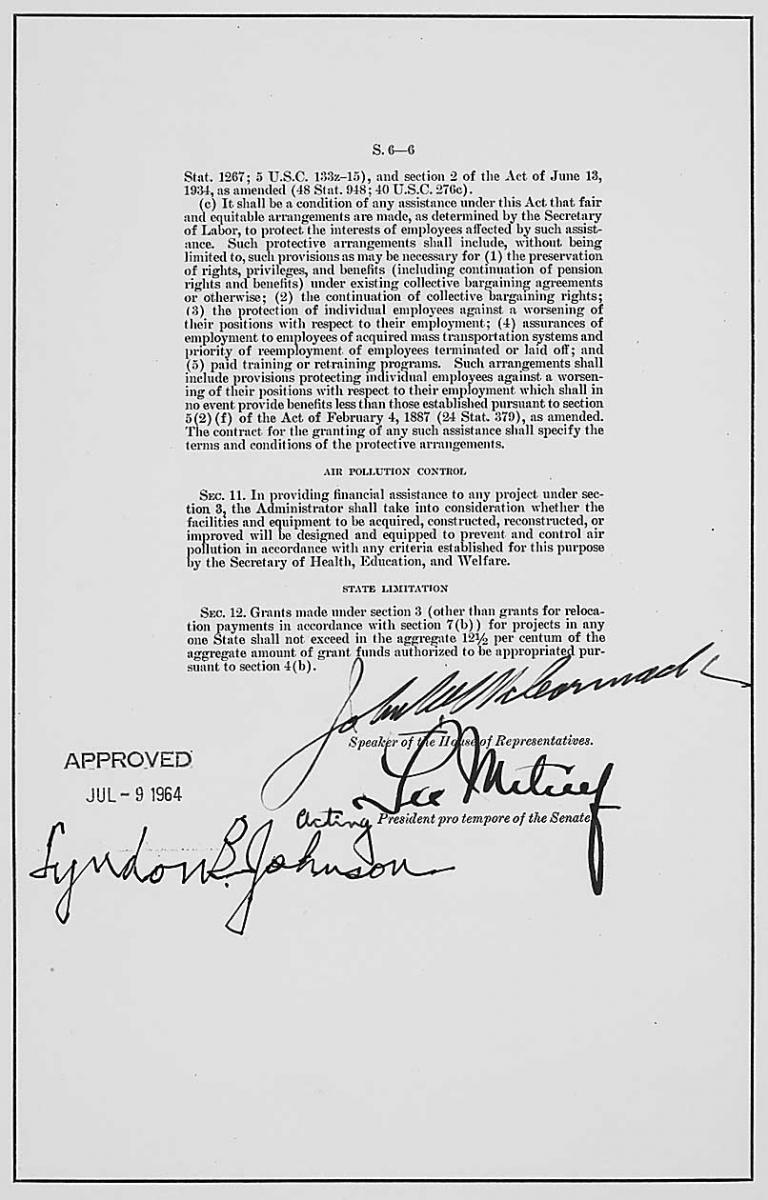
The entire process began when President Lyndon B. Johnson signed the Urban Mass Transportation Act of 1964 into law in response to the nation’s long-term transportation investment needs. The new law provided grant and loan money to local transportation systems and created an oversight agency, the Urban Mass Transportation Administration (UMTA), which would be renamed the Federal Transit Administration (FTA) in 1991. The Metropolitan Transportation Commission (MTC) then was put together by the California State Legislature in 1970 and tasked with reviewing transportation grant applications submitted by agencies in the state. 
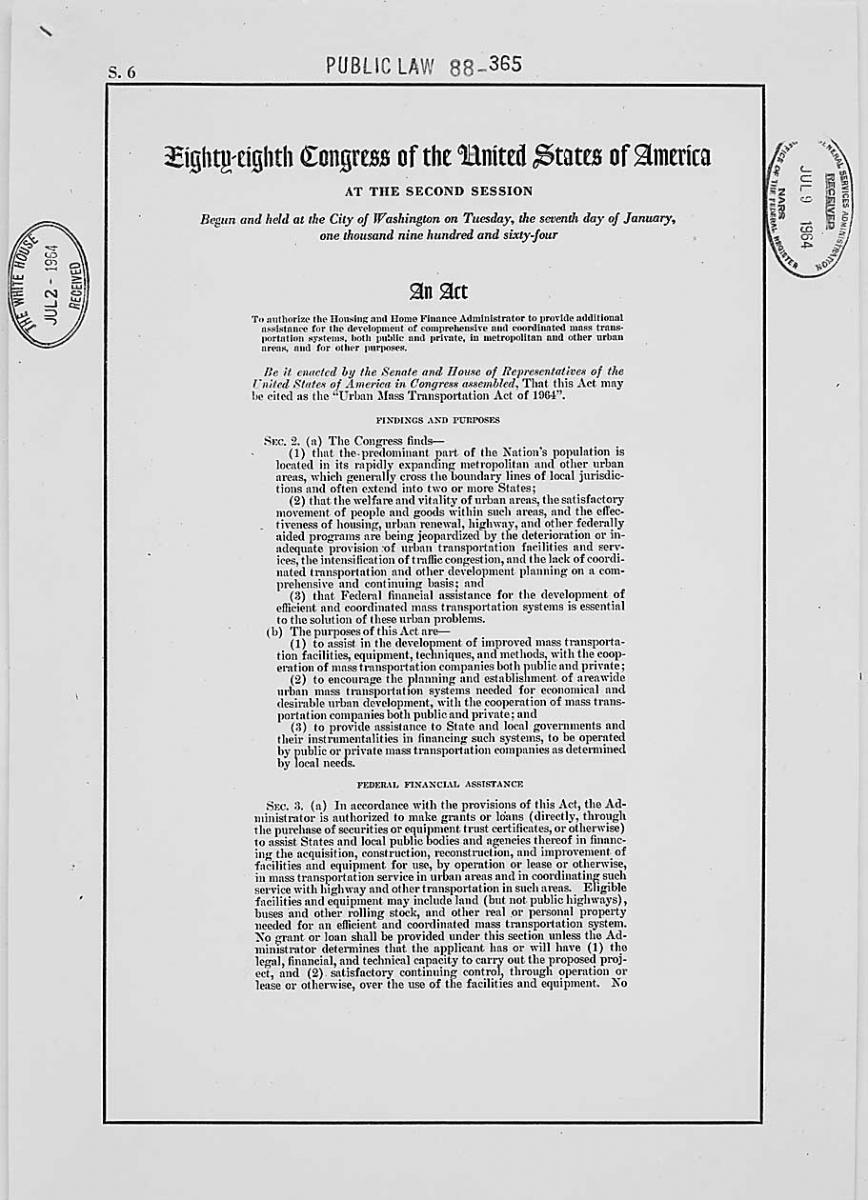
Text of documentation with signatures towards the bottom of the page with time stamped notation of 1964


Text of documentation with signatures towards the bottom of the page with time stamped notation of 1964

Urban Mass Transportation Act of 1964, Public Law 88-365, 78 STAT 302

An in-depth study of Muni was undertaken in 1974 by Wilbur Smith & Associates, a private consultant and author of the UMTA’s Characteristics of Urban Transportation Demand: A Handbook for Transportation Planners. The Municipal Railway Planning, Operations and Marketing (POM) Study was completed in 1977 and analyzed the Muni system and the travel needs of its riders and made recommendations for a 5-Year Plan. 

 A new in-house Muni Planning Division that had been created with UMTA funding in 1974 presented the POM Study at more than 70 community meetings, and after intense review and several revisions, The San Francisco Municipal Railway 5-Year Plan, 1979-1984 was drafted. 
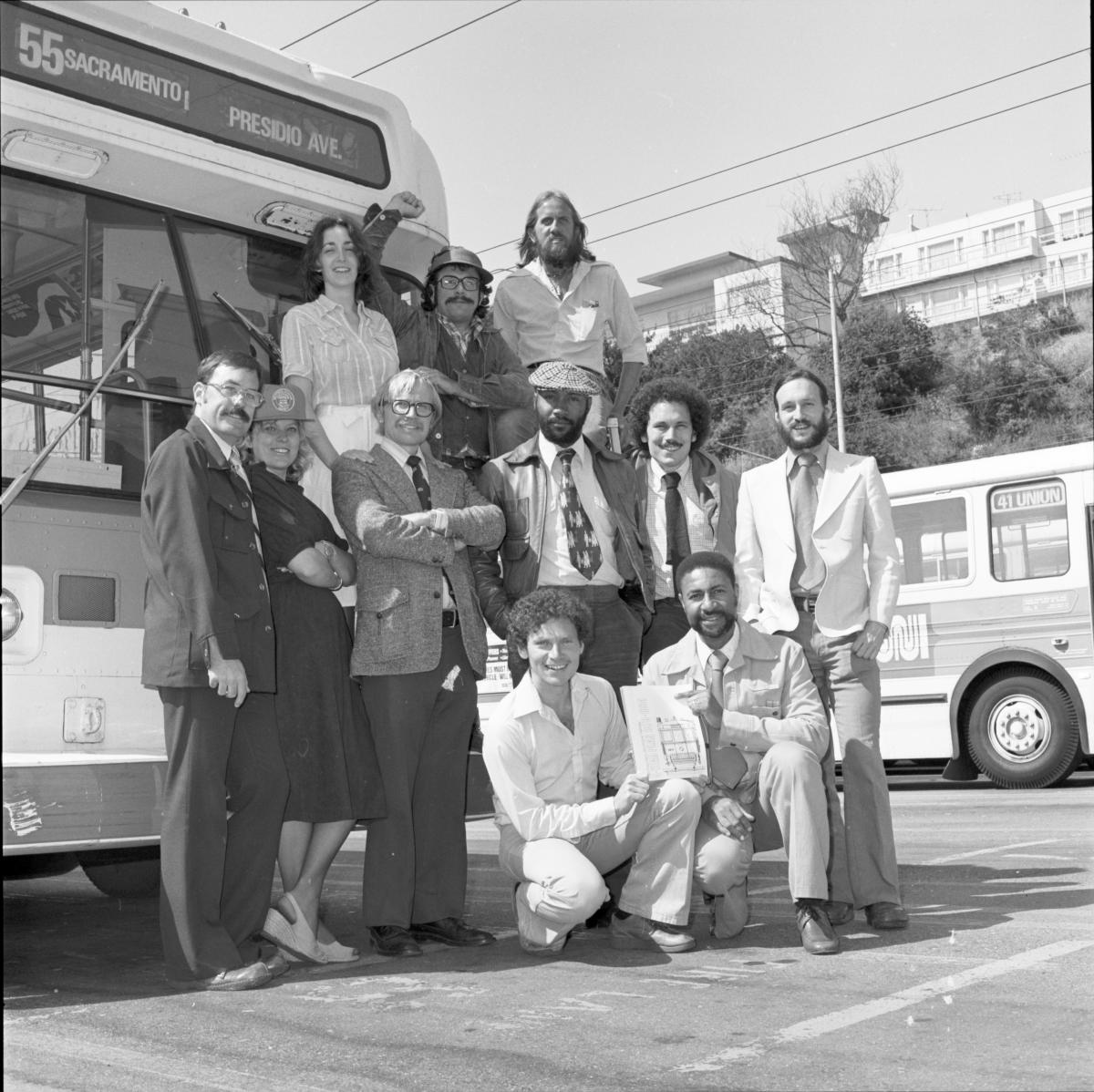
A dozen people dressed in business casual posting for a group photo in front of a bus in what seems to be a bus yard. They are positioned in several different tiers.

Muni Planning Division Employees in Presidio Trolley Coach Yard, May 17, 1979

Since that first plan was written, transportation planning at the SFMTA has expanded to include capital projects, street design, bike lanes, paratransit, parking, historic streetcars and much more, while promoting safety, equity and sustainability. The SFMTA continues to publish an operating and service plan approximately every 10 years, now called the Short-Range Transit Plan (SRTP), which is based on the needs, goals and agency priorities to serve the people of San Francisco. 


Published March 31, 2023 at 01:26AM
https://ift.tt/BfWLqy0

Nhận xét

Bài đăng phổ biến từ blog này

Đảm bảo tiêu chí Coherence và Cohesion trong IELTS Writing

Coherence & Cohesion là một trong bốn tiêu chí chủ chốt để đánh giá bài IELTS Speaking và Writing . Trong bài viết dưới đây, mời các bạn cùng IELTS Vietop tham khảo lại định nghĩa và những cách để đảm bảo tiêu chí Coherence và Cohesion trong IELTS Writing nhé! Tiêu chí Coherence và Cohesion trong IELTS Writing là gì? Tiêu chí Coherence & Cohesion là hai khía cạnh quan trọng trong việc đánh giá và phân tích một bài IELTS Writing. Trong đó: Tiêu chí Coherence và Cohesion trong IELTS Writing là gì Coherence (tính liên kết): Mức độ mà các ý tưởng trong văn bản liên kết với nhau một cách hợp lý và có tổ chức. Nó đảm bảo rằng các ý tưởng trong văn bản được trình bày theo một cách mạch lạc và dễ hiểu. Người viết cần sử dụng các từ nối, cụm từ, và cấu trúc câu hợp lý để giúp cho các ý tưởng trong văn bản được trình bày một cách logic và mạch lạc. Cohesion (tính gắn kết): Mức độ mà các câu trong văn bản gắn kết với nhau một cách hợp lý và tự nhiên. Nó đảm bảo rằng các câu t...

IELTS Reading – Cách xử lý dạng câu hỏi True False Not given

Đối với các bạn đang luyện tập và chuẩn bị cho kỳ thi IELTS sắp tới, một trong những dạng bài quen thuộc nhưng khá khó đối phó chính là dạng bài True False Not Given . Dạng bài này thường bị nhầm lẫn với dạng bài Yes/ No/ Not Given và hay bị nhầm lẫn trong kết quả. Hãy cùng IELTS Vietop chinh phục dạng bài này trong bài viết dưới đây nhé! Tổng quan về dạng bài True False Not Given trong IELTS True False Not Given là một trong những dạng bài xuất hiện trong phần bài đọc của bài thi IELTS. Thường trong mỗi bài đọc sẽ xuất hiện một bài tập dạng True/False/Not Given với độ dài khoảng 5 – 7 câu. Dạng bài này đánh giá khả năng đọc hiểu của thí sinh.  Đề bài sẽ đưa ra các mệnh đề chứa nội dung liên quan đến bài đọc. Thí sinh sẽ phải đọc thông tin trong bài và đưa ra đáp án rằng mệnh đề đó đúng, sai hay không có thông tin.  Phân biệt hai dạng bài True/False/Not Given và Yes/ No/ Not Given Dạng bài True False Not Given thường hay bị nhầm với dạng bài Yes No Not Given. Hai dạng bà...

Writing samples: Physical activities

Luyện thi IELTS Vietop  gửi bạn bài Writing samples: Physical activities   bên dưới nhé! Các bạn theo dõi và ôn luyện  IELTS Writing  thật tốt nhé! Task 1: The bar chart below shows the percentage of Australian men and women in different age groups who did regular physical activity in 2010. The bar chart depicts the percentages of Australian males and females in various age groups who exercised regularly in 2010. Overall, men’s engagement peaked between the ages of 15 and 24, while women’s participation peaked in the 45 to 54 age group. Besides, in every age group save the youngest, more women than men participated in regular exercise. Women in the youngest age group who regularly exercised were 47.7%. After then, their participation increased significantly with age, peaking at 3% over a half in the 45-54 age group. Above that, it began to deteriorate, with only 47.1% of people in the most senior age group engaging in regular workout. The lowest age ...